
THE ALAN BOYSON HULL ART TRAIL
The former Hull Co-op / BHS building is unique for having three Boyson artworks. Hull is the only city to have this many Boyson murals.
Skyline mural (1963)
Alan Boyson’s Sponge-Print Tile Mural
The Skyline geometric sponge print mural was created by Alan Boyson in 1963 for the Skyline Ballroom bar, on the fourth floor of Hull’s Co-operative Society building. Using sponges to imprint bold geometric forms onto blank Hereford tiles, Boyson produced a vibrant, rhythmic wall piece that complemented the modernist spirit of the new department store and ballroom.
At the time of its creation, the Skyline Ballroom was a social hub for Hull, embodying a sense of post-war renewal after the destruction of the 1943 Hull Blitz. The mural was part of a trio of Boyson commissions for the building, alongside the monumental Three Ships mosaic and the Fish mural.
Historical Context
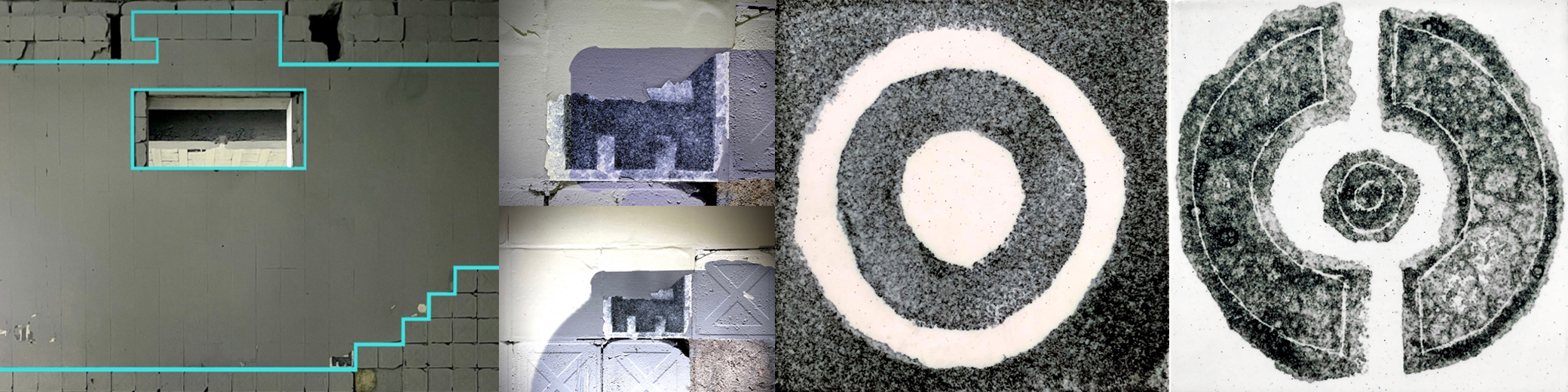
The mural was one of Boyson’s most innovative uses of ceramic surface design. Working with Hereford tiles, Boyson produced 658 tiles (each 100mm × 100mm) arranged into a grid of 12 different sponge-printed patterns. Each tile was sponge-printed with geometric motifs before being finished with a protective lacquer.
The Kodak slide, taken by the building architect E.P. (Philip) Andrew in 1963, shows the mural in its original setting, adding to its value as a rare surviving example of Boyson’s experimentation with this technique.
The Skyline Ballroom—originally opened in the early 1960s—underwent a colourful transformation over the decades. In the 1970s, it became Bailey’s Nightclub, renowned for its Northern Soul scene and live acts, including appearances from Eartha Kitt, Adam Faith, and Tom Jones. In the late 1970s it was rebranded as Romeo’s & Juliet’s, a pivotal venue in Hull’s nightlife through the 1980s and early 1990s. However, its run ended abruptly after a dramatic police drugs raid in November 1991. It remains unclear whether the Skyline mural was damaged during either nightclub phase.
Rediscovery
The mural fell into obscurity as alterations to the building enclosed the ballroom interior. Less than half of the original tiles survived, and for many years the mural was believed to be lost. It was through a 2018 interview with architect E.P. (Philip) Andrew, conducted by Esther Johnson, Leigh Bird and Christopher Marsden as part of SHIPS in the SKY that Christopher Marsden was able to identify the mural’s existence from original plans that Philip had. Later in 2018 Hull City Council confirmed in 2018 that partial remains of the mural had been found in the building.
Conservation & Reinstatement
The survival of Skyline posed both a challenge and an opportunity. As the last known example of Boyson’s sponge-print technique, each remaining tile was carefully removed by Heritage Project Contracts. Out of the 658 original tiles, 396 were missing and had to be painstakingly re-created by hand.
A specialist team at Craven Dunnill (Jackfield) Ltd replicated the missing patterns, undertaking an extensive programme of colour trials and sponge-print testing to ensure that the new tiles matched Boyson’s original artistic intent. In this way, the reinstated mural remains true both to the surviving tiles and to Boyson’s vision.
Today, the restored Skyline has been reinstalled in the new NHS Community Diagnostic Centre (CDC) at Albion Square, Hull. It is now on permanent public display — visible both up close to visitors inside the building and 24 hours a day through large street-facing windows.
> View MAP LOCATION
Explore Further
< Back to the Alan Boyson Hull Art Trail

Kodak colour slide of the mural in-situ in the Skyline bar. Photo by E.P. (Philip) Andrew, March 1963.

The marked area indicates the remaining original tiles of the mural beneath encapsulation paint during asbestos removal inside the building. Photo by Esther Johnson, 2022.


The restored Skyline mural installed in the NHS Community Diagnostic Centre on Albion Street, Hull. Photo by Esther Johnson, 2025.